Magnetoencephalography Using Optically Pumped Magnetometers (OPM-MEG)
Established in May 2026, the OPM-MEG Core Facility provides state-of-the-art infrastructure for magnetoencephalography (MEG) using quantum-based optically pumped magnetometers (OPMs). As an advanced functional neuroimaging technique, OPM-MEG enables the non-invasive measurement of the extremely weak magnetic fields generated by neuronal activity, offering direct recordings of brain function with millisecond temporal resolution.
Compared with conventional cryogenic MEG systems, OPM-MEG offers several important advantages. Because the sensors are placed directly on the scalp, the distance between the sensors and the brain is substantially reduced, resulting in improved signal-to-noise ratio and enhanced spatial resolution. Furthermore, the compact size of OPM sensors allows them to be integrated into wearable helmets that can be adapted to different head sizes, making the technology particularly suitable for studies involving both adults and children.
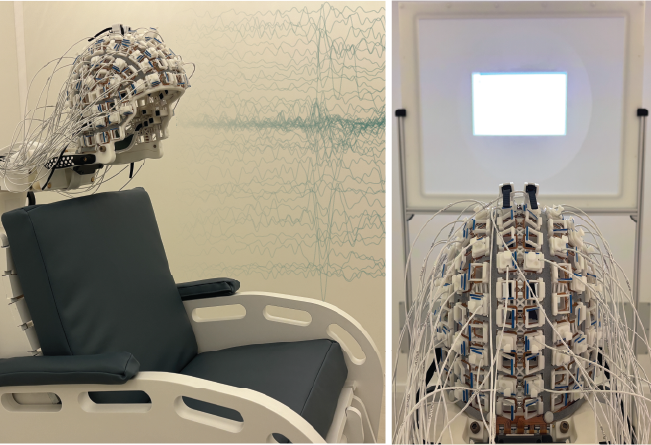
The OPM-MEG laboratory at CBBM is equipped with a HEDscan OPM-MEG system (FieldLine Medical Inc.). The system comprises a wearable helmet with 144 sensor slots that can accommodate up to 64 OPM sensors distributed across the entire head. Because OPM sensors require an environment with extremely low ambient magnetic fields, the system is housed within a magnetically shielded room (Vaccumschmelze GmbH; dimensions: 3.9 m × 2.9 m × 2.38 m).
In addition, the facility includes a comprehensive stimulus presentation and experimental control setup (VPixx Technologies), enabling a wide range of cognitive and behavioral neuroscience experiments during MEG acquisition. The setup features a projector and screen for visual stimulus presentation, an audio module with in-ear headphones, two response pads for recording manual responses, and a binocular MEG-compatible eye-tracking camera.
The OPM-MEG Core Facility will significantly strengthen human neuroscience research in Lübeck by advancing both neuroimaging methodology and translational neuroscience. Its primary areas of application include: (1) the investigation of cognitive and social processes across the lifespan, particularly in children and older adults, and (2) research into the neural mechanisms underlying movement, neurological, and psychiatric disorders.

Scientific Lead
Prof. Dr. Jonas Obleser
Tel.: +49 451 3101 3620
Email: jonas.obleser(at)uni-luebeck.de